Loading
Timeline
Three centuries of inquiry
How the question of what follows death moved from scripture and philosophy into hospitals and laboratories, and who carried it there.
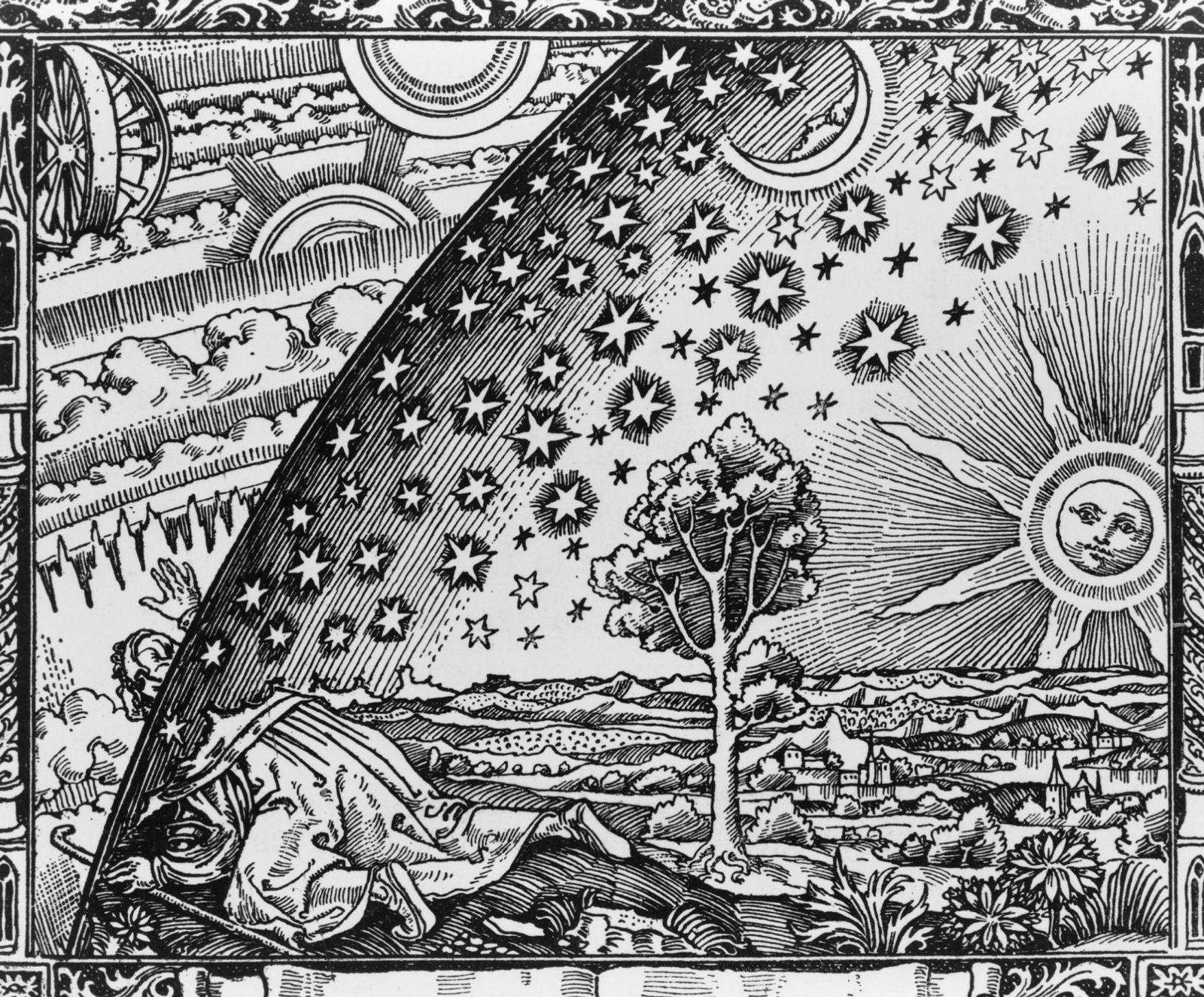
The Flammarion engraving, 1888
Twelve lives
The pioneers, drawn to scale
Each bar runs from birth to death, or to the present for those still living.
- Emanuel Swedenborg1688–1772
- William James1842–1910
- Hazur Sawan Singh Ji1858–1948
- Robert A. Monroe1915–1995
- Ian Stevenson1918–2007
- Elisabeth Kübler-Ross1926–2004
- Michael Newton1931–2016
- Dolores Cannon1931–2014
- Kenneth RingBorn 1935
- Pim van LommelBorn 1943
- Raymond MoodyBorn 1944
- Bruce GreysonBorn 1946
Key moments
From the Phaedo to AWARE II
Each entry links to the page where it is described and cited.
- Tradition and philosophy
- Landmark publication
- Research
- Sceptical research
c. 360 BCE
Plato's Phaedo
Plato sets out arguments for the immortality of the soul.
Tradition and philosophy
1758
Heaven and Hell
Swedenborg publishes his description of the spiritual world.
Tradition and philosophy
1882
Society for Psychical Research
Founded in London to investigate claims of survival systematically.
Research
1892
Heim's mountaineers
Albert Heim publishes accounts from climbers who survived falls.
Research
1898
Human Immortality
William James argues that the brain might transmit consciousness.
Landmark publication
1902
The Varieties of Religious Experience
James studies mystical experience as a fact of psychology.
Landmark publication
1927
The Tibetan Book of the Dead in English
Evans-Wentz publishes the first English edition of the Bardo Thödol.
Tradition and philosophy
1958
Monroe's experiences begin
Robert Monroe starts recording his out-of-body experiences.
Research
1966
Twenty Cases Suggestive of Reincarnation
Ian Stevenson publishes his first collection of cases.
Landmark publication
1967
A research unit at Virginia
Stevenson founds what is now the Division of Perceptual Studies.
Research
1968
The "Miss Z" experiment
Charles Tart tests a reported out-of-body experience in the laboratory.
Research
1969
On Death and Dying
Elisabeth Kübler-Ross changes how medicine speaks to the dying.
Landmark publication
1975
Life After Life
Raymond Moody names the near-death experience.
Landmark publication
1980
Life at Death
Kenneth Ring publishes one of the first systematic studies.
Research
1983
The NDE Scale
Bruce Greyson gives researchers a common measure.
Research
1991
Regression under test
Spanos and colleagues show that past-life identities follow expectation.
Sceptical research
2001
The Lancet study
Van Lommel's team reports on 344 cardiac arrest survivors.
Research
2002
An out-of-body sensation induced
Blanke's team triggers the sensation by stimulating the brain.
Sceptical research
2011
"Nothing paranormal"
Mobbs and Watt argue that neuroscience explains every element.
Sceptical research
2014
The AWARE study
A study of 2,060 cardiac arrests across 15 hospitals.
Research
2023
AWARE II
Brain activity is recorded during prolonged resuscitation.
Research