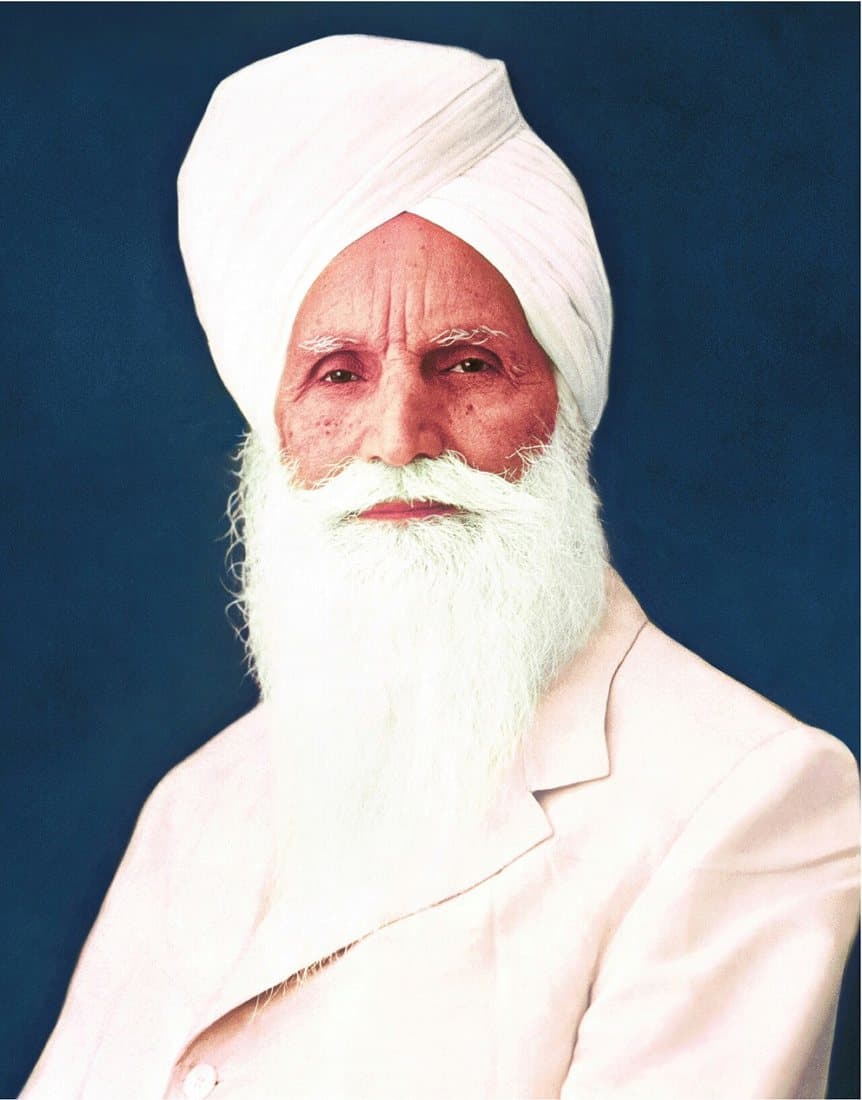
Hazur Sawan Singh Ji
Sant Mat teacher, Radha Soami Satsang Beas
Born in Punjab, 1858. Died at Beas, Punjab, 1948.
He led the Beas community from 1903 until his death and taught a path of meditation through inner spiritual regions.
Biography
Sawan Singh was born into a Sikh family in the Punjab and worked for many years as an engineer in the military engineering service of British India. In 1894 he met Baba Jaimal Singh, the founder of the spiritual community at Beas, and was initiated by him.
On Jaimal Singh's death in 1903 he became the community's spiritual head, a position he held for forty-five years. Under him the settlement on the Beas river grew into a large centre, and he initiated well over a hundred thousand followers, including some of the first from Europe and North America. Devotees call him the Great Master.
Historical context
Sant Mat, the "teaching of the saints", draws on the devotional poet-saints of northern India such as Kabir and Guru Nanak. The Radha Soami movement, to which the Beas community belongs, began in Agra in the nineteenth century.
Teachings
He taught a meditation practice known as Surat Shabd Yoga, the joining of the soul with an inner sound or divine current, under the guidance of a living teacher. Followers adopt a vegetarian diet, abstain from alcohol and drugs, and commit to daily meditation.
The teaching describes an ascent through inner regions: the physical, the astral and the causal, and then purely spiritual regions beyond the reach of mind, ending in Sach Khand, the true or imperishable realm, from which the soul is said to have come.
Key concepts
- Surat Shabd Yoga
- Meditation on inner sound and light, the central practice of Sant Mat.
- The inner regions
- Physical, astral and causal regions, followed by purely spiritual ones.
- Sach Khand
- The "true realm", described as the soul's original home and final destination.
Criticism and limits
The inner regions are known through the reports of teachers and practitioners and are matters of faith and personal practice, not public evidence. Scholars such as Mark Juergensmeyer and David Lane have studied the movement's history, including disputes over succession between its branches.
References
Sawan Singh. Philosophy of the Masters (Gurmat Sidhant), 5 vols. Beas: Radha Soami Satsang Beas.
Spiritual teachingSawan Singh. Spiritual Gems. Beas: Radha Soami Satsang Beas.
Spiritual teachingJuergensmeyer, M. (1991). Radhasoami Reality: The Logic of a Modern Faith. Princeton: Princeton University Press.
Historical sourceJohnson, J. (1939). The Path of the Masters. Beas: Radha Soami Satsang Beas.
Spiritual teaching