Module · 8 minutes
Understanding near-death experiences
What people report, how researchers study it, and why they disagree about what it means.
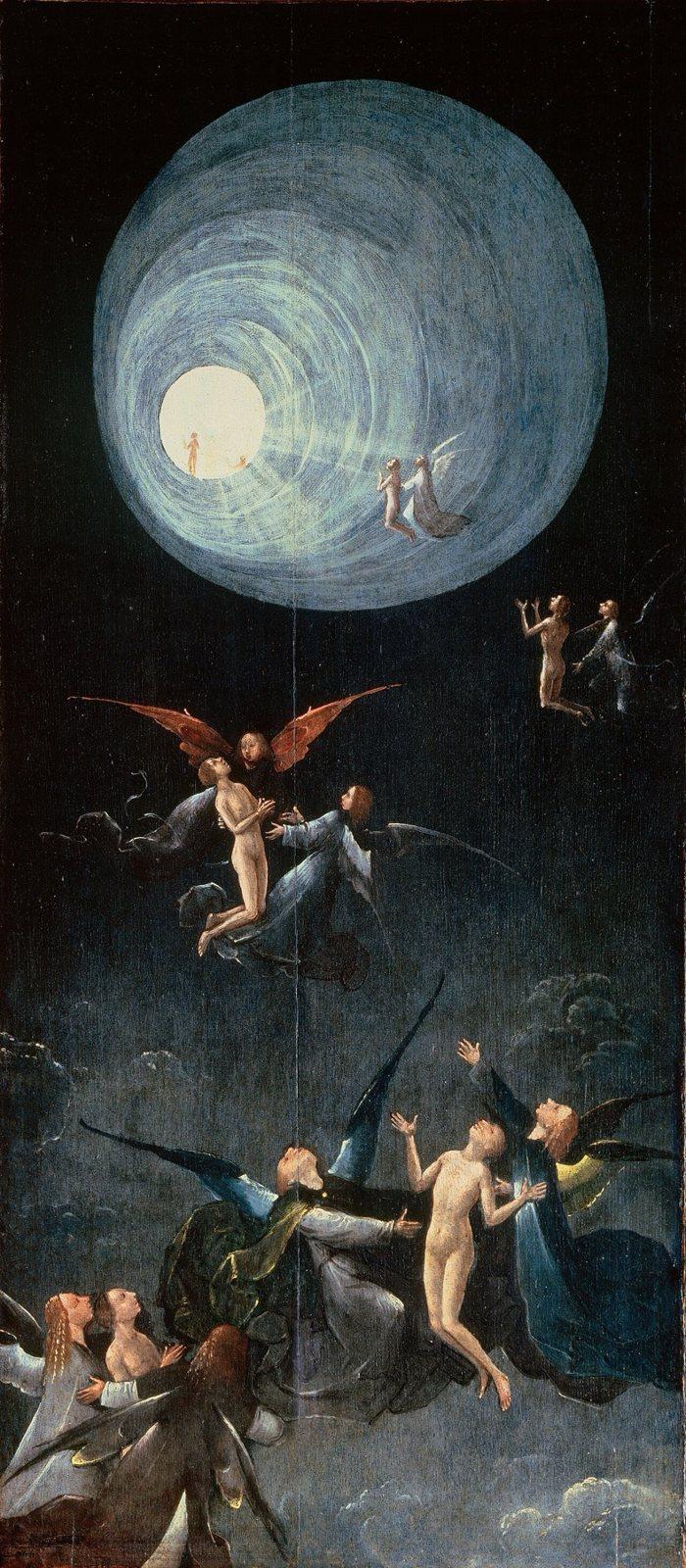
Hieronymus Bosch, Ascent of the Blessed, c. 1505–1515
Part 1 of 4
What a near-death experience is
A near-death experience is a vivid experience reported by some people who have come close to death, most often after cardiac arrest. Raymond Moody introduced the term in 1975 after collecting accounts that resembled one another.
People describe feelings of peace, a sense of leaving the body, moving through darkness, encountering a light, meeting people who have died and, less often, reviewing their own lives. No one reports every element.
Part 2 of 4
How it is studied
Early collections relied on people who volunteered their stories. Later researchers built better tools. Bruce Greyson's 1983 scale gave a consistent way to decide what counts as a near-death experience.
Prospective studies then interviewed every survivor of cardiac arrest in a hospital, soon after the event. A Dutch study published in The Lancet in 2001 found that 18% of 344 survivors reported one.
Part 3 of 4
Two ways of reading the evidence
Many neuroscientists hold that each element has a basis in a brain under extreme stress: loss of oxygen, bursts of activity as the heart stops, and the intrusion of dream-like states.
Other researchers argue that some features, such as clear thinking when the brain is barely functioning, are hard to account for in this way. They treat this as a reason to keep the question open, and most do not claim it proves survival of death.
Part 4 of 4
What stays true either way
Whatever the cause, the experiences are real events in people's lives. Follow-up studies find lasting changes, including less fear of death and a greater concern for other people.
For anyone who has had such an experience, or who is grieving, the scientific debate may matter less than being heard. Both things can be respected at once.
Check your understanding
A short quiz
The questions are about what the sources say and what kind of evidence they are. None asks what you believe.
0 of 4 answered.